Minority Women and Western Media by Maha Bashri and Sameera Ahmed
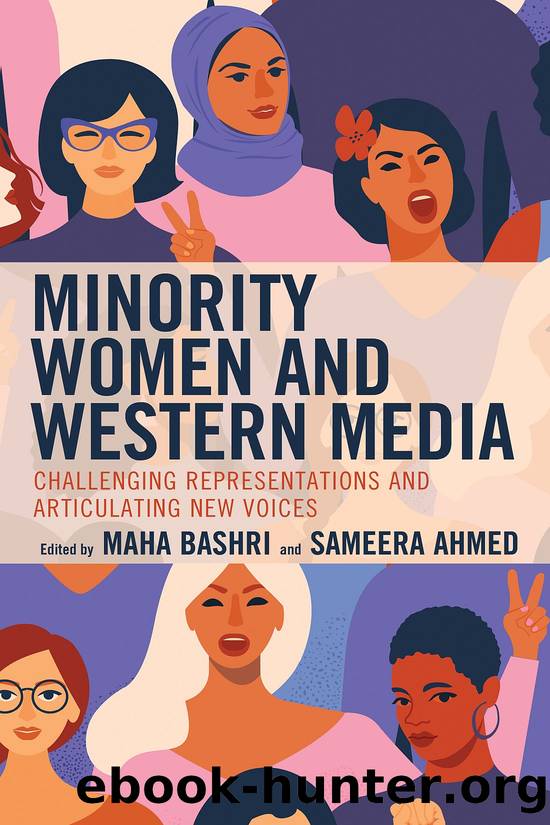
Author:Maha Bashri and Sameera Ahmed
Language: eng
Format: epub
ISBN: 9781498599863
Publisher: Lexington Books
Chapter 5
Iranian Women and the Media
The Good, the Bad, and the Untold
Zahra Jafari
Misrepresentations of Iranian womenâs rights and social and cultural practices are not a new phenomenon in Western media. Pervasive Western narratives of âoppressedâ Iranian women usually focus on legislated dress codesâor the hijab as a visual signifier of oppression to be specificâafter the Islamic Revolution. These narratives perpetuate misconceptions about Iranian womenâs social status by juxtaposing the image of the emancipated Pahlavi1 woman with the âoppressedâ postrevolutionary woman. The one-sided account these media narratives present on cultural issues such as the hijab, without establishing any of its nuanced details to their target audience, hence becomes problematic and misleading. Quite contrary to the assumption that mandatory dress codes are by-products of postrevolutionary politico-religious ideologies, womenâs dress codes were also regulated prior to the Islamic Revolution for different political and (anti)religious purposes in Iran. Thus, the inaccuracies and misinformation prevalent in Western narratives about the sociopolitical changes in Iran inevitably generate a distorted view of Iranian women and their social status. In turn, this perpetuates stereotypes and purveys gendered myths about them.
The strained Iran-West relations following the Islamic Revolution in 1979 have inexorably influenced how Western media rhetorically craft and propagate a biased image of Iranian women. Nowadays, plastering loaded images of veiled Iranian women across different outlets that discuss and critique Iranian womenâs rights has become a commonality in Western media. Often, the gender discourses in these media engage in creating a âgoodâ prerevolutionary versus âbadâ postrevolutionary view of Iranian women, while the underlying messages in these narratives ultimately project a voiceless, oppressed, and passive image of Iranian women, in jarring incongruity with what Iranian mediaâs representation of âIranian femininityâ has been since the establishment of the Islamic Republic of Iran.
In the first part of this chapter, similar to the view of mandatory hijab as a limitation of womenâs freedom of choice and the restriction of their rights, I look at the prerevolutionary dress regulations as systematic/structural discrimination against Iranian women and a violation of their rights. Therefore, I consider women of Pahlaviâs regime who, because of a ban on the hijab, experienced discrimination, violence, and subsequent seclusion as oppressed women not represented in Western narratives. In this context, I argue that before the Islamic Revolution, it was the voice of dissent belonging to these women that was silenced.
Following this, the second part of the chapter investigates the representation of Iranian women in the postrevolutionary era of Mohammad Khatami (1997â2005), with a focus on the medium of film. In order to provide a counterview to the prevailing narratives of Iranian women in the media, the discussion will focus on selected women-centric films that played instrumental roles in eliminating reductionist and/or sexist representations of Iranian women in cinema during this time. Special attention will be given to those movies that enjoyed both box office success and critical acclaim as they contributed greatly to shifting and dismantling boundaries of gender discourse in Iranian cinema. These movies carved out new spaces for
Download
This site does not store any files on its server. We only index and link to content provided by other sites. Please contact the content providers to delete copyright contents if any and email us, we'll remove relevant links or contents immediately.
| Anthropology | Archaeology |
| Philosophy | Politics & Government |
| Social Sciences | Sociology |
| Women's Studies |
Born to Run: by Christopher McDougall(7127)
The Leavers by Lisa Ko(6948)
iGen by Jean M. Twenge(5416)
Sapiens by Yuval Noah Harari(5371)
Spare by Prince Harry The Duke of Sussex(5197)
The Kite Runner by Khaled Hosseini(5179)
Machine Learning at Scale with H2O by Gregory Keys | David Whiting(4313)
Bullshit Jobs by David Graeber(4190)
Never by Ken Follett(3957)
Goodbye Paradise(3810)
Livewired by David Eagleman(3775)
Fairy Tale by Stephen King(3399)
A Dictionary of Sociology by Unknown(3085)
Harry Potter 4 - Harry Potter and The Goblet of Fire by J.K.Rowling(3074)
The Social Psychology of Inequality by Unknown(3031)
The Club by A.L. Brooks(2925)
Will by Will Smith(2920)
0041152001443424520 .pdf by Unknown(2846)
People of the Earth: An Introduction to World Prehistory by Dr. Brian Fagan & Nadia Durrani(2738)
